
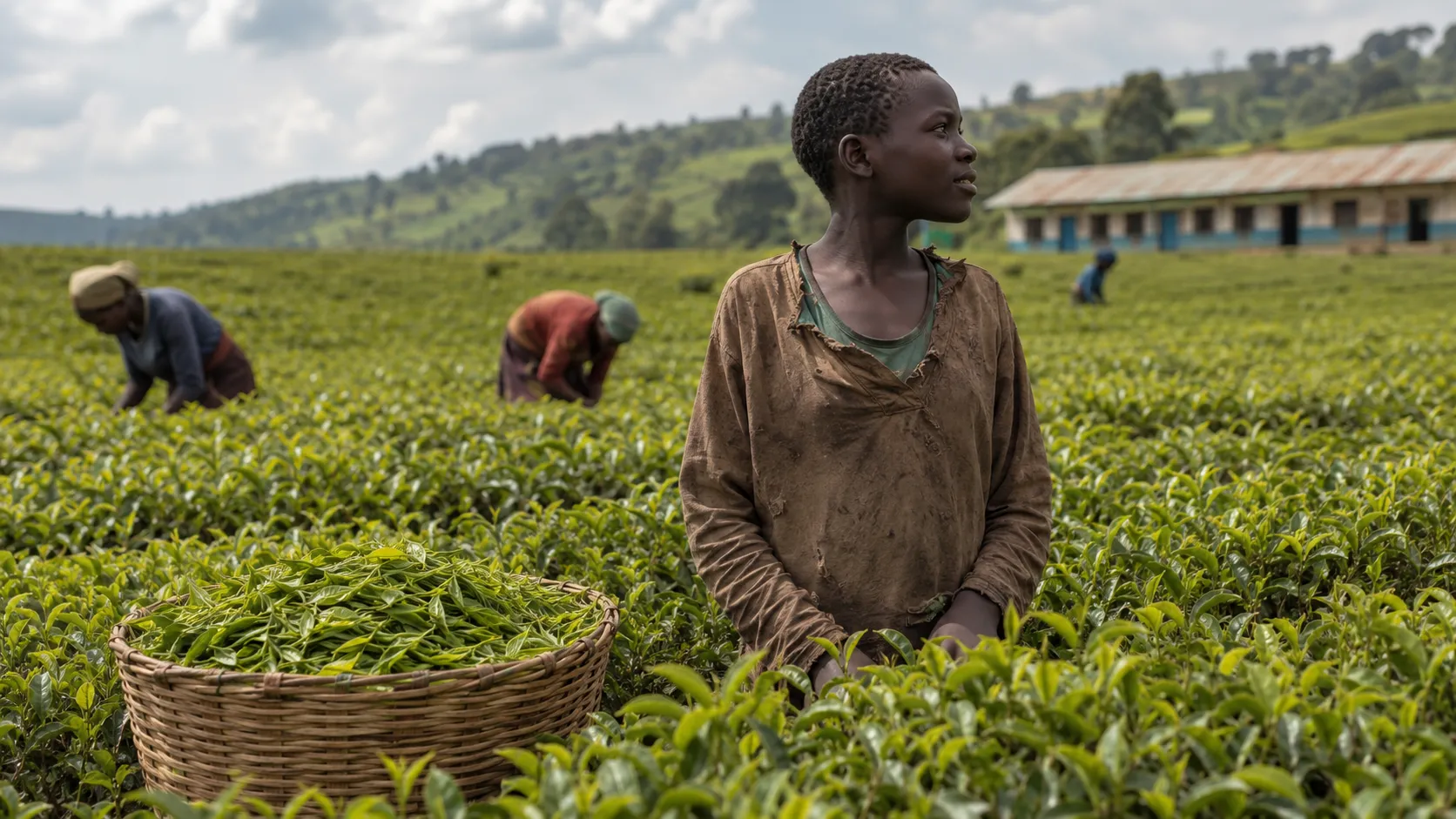
Child labour in Kenya affects an estimated 1.3 million children aged 5 to 17, robbing them of education, safety, and the simple right to be a child.
A childhood should be filled with learning, laughter, curiosity, and dreams. Yet for millions of children, it is cut short by work that steals time from classrooms, playgrounds, and the experiences that shape a healthy future.
This International Day Against Child Labour, the global community unites under the theme “Red Card to Child Labour: Fair Play for Children, Decent Work for Adults.” The message is clear: children belong in schools and safe spaces, while adults deserve decent jobs that support their families with dignity.
How Many Children Are in Child Labour in Kenya?
The scale of child labour in Kenya remains deeply concerning. According to data from the Kenya National Bureau of Statistics (KNBS), approximately 1.3 million children between the ages of 5 and 17 are engaged in child labour across the country. While Kenya has made notable progress over the years, poverty, climate-related shocks, inequality, and regional disparities continue to push children into work instead of school.
Globally, the picture is equally troubling. The International Labour Organization (ILO) and UNICEF Global Estimates of Child Labour 2024 report that an estimated 138 million children worldwide are engaged in child labour, with nearly 54 million involved in hazardous work that threatens their health, safety, and development. Sub-Saharan Africa carries the heaviest regional burden, accounting for nearly two-thirds of all children in child labour, around 87 million.
What Causes Child Labour in Kenya?
Child labour rarely happens in isolation. In Kenya, as in most of Sub-Saharan Africa, it is driven by a combination of interconnected factors:
- Extreme poverty that forces families to rely on children’s income for survival
- Climate-related shocks that devastate agricultural livelihoods, particularly in arid and semi-arid regions
- Limited access to quality education, especially in rural and informal settlement areas
- Weak social protection systems that leave vulnerable households without a safety net
- Gender inequality, which puts girls at disproportionate risk of domestic labour and early marriage
Understanding these root causes is essential — because ending child labour in Kenya requires addressing the conditions that make it feel necessary in the first place.
The Effects of Child Labour on Kenyan Communities
Child labour often begins as a survival strategy. But its long-term effects on communities are far-reaching and deeply damaging.
When children leave school to work, their education suffers, limiting future opportunities and entrenching intergenerational poverty. Communities lose the teachers, innovators, entrepreneurs, and leaders those children might have become. Children engaged in labour are also more vulnerable to exploitation, abuse, and hazardous conditions. Instead of building social skills through play, learning, and positive relationships, they are forced to carry responsibilities far beyond their years.
The result is a cycle that weakens communities and undermines social stability. A peaceful society cannot be built when children are denied the opportunity to develop their full potential.
Child Labour and Peacebuilding: Understanding the Connection
At Re-Imagining New Communities, we believe that peace is more than the absence of violence. Peace is the presence of opportunity, dignity, safety, and hope.
This is why ending child labour is not only a child protection issue, it is a peacebuilding issue.
The ILO’s research on child labour across the Humanitarian-Development-Peace Nexus confirms what communities on the ground already know: child labour thrives in environments of instability, conflict, and economic fragility. Addressing it requires coherent, long-term strategies that link humanitarian support, development cooperation, and active peacebuilding, not short-term, isolated interventions.
When children are educated, protected, and given space to grow, they become the architects of more stable, more peaceful communities. When they are not, that potential is lost, often permanently.
Fair Play for Children: Safe Spaces Matter
Fair play means ensuring every child has access to education, protection, recreation, and supportive environments where they can grow and flourish. It means recognising that childhood itself is a right, not a luxury reserved for the privileged few.
Playgrounds, schools, community centres, libraries, sports fields, and youth programmes are not optional extras. They are the spaces where children build confidence, resilience, friendships, and life skills. When we protect these spaces, we invest directly in a more peaceful future.
UNICEF’s integrated approach to ending child labour highlights that expanding access to quality education and strengthening community child-protection systems are among the most proven strategies for keeping children out of work and in school. Kenya’s own partnership with the ILO through the ACCEL Africa Project — targeting cocoa, gold, cotton, tea, and coffee supply chains — is a strong step in this direction.
Decent Work for Adults: The Other Side of the Equation
The fight against child labour in Kenya cannot succeed without addressing the economic realities facing families.
Most parents do not want their children to work. They want them to learn, succeed, and have better opportunities than they had. But low wages, unemployment, and economic insecurity leave many families with impossible choices.
Decent work for adults means fair wages, safe working conditions, stable employment, and economic opportunities that allow parents and caregivers to provide for their households, without relying on their children’s labour. When adults earn enough to support their families, children are more likely to stay in school, communities become more stable, and the foundations for peace grow stronger.
This dual focus, protecting children while empowering adults, is central to the ILO’s “Red Card to Child Labour” campaign and must be central to Kenya’s national response as well.
How to End Child Labour in Kenya: A Collective Responsibility
Ending child labour demands action at every level. Governments, employers, schools, civil society organisations, communities, and individuals all have a role to play.
Some of the most impactful actions include:
- Advocating for and enforcing Kenya’s child labour laws, including the Employment Act and the Children Act
- Investing in social protection programmes that reduce economic pressure on vulnerable families
- Supporting quality, accessible education, particularly for girls and children in rural areas
- Promoting ethical supply chains that hold businesses accountable for labour practices
- Creating safe community spaces where children can learn, play, and thrive
The 6th Global Conference on the Elimination of Child Labour held in Marrakech in 2026 reaffirmed the urgent need to accelerate action and produced a roadmap for tackling child labour through integrated, rights-based responses. Kenya must be an active part of that momentum.
Re-Imagining a Future Free from Child Labour
As we mark the International Day Against Child Labour on June 12, we are reminded that building peaceful communities requires collective courage and commitment.
At Re-Imagining New Communities, we envision a future where every child in Kenya, and across the continent, carries books rather than burdens, where dreams are nurtured rather than delayed, and where peace begins by protecting the rights and dignity of the youngest members of our society.
Today, we raise a symbolic red card to child labour. Together, let us choose education over exploitation, opportunity over vulnerability, and safe spaces over unsafe work.
Because every child deserves a childhood. And every community deserves the peace that comes when children are free to learn, play, and thrive.
Re-Imagining New Communities is a peacebuilding organisation working to create safe, dignified, and opportunity-rich environments for children and communities across Kenya.