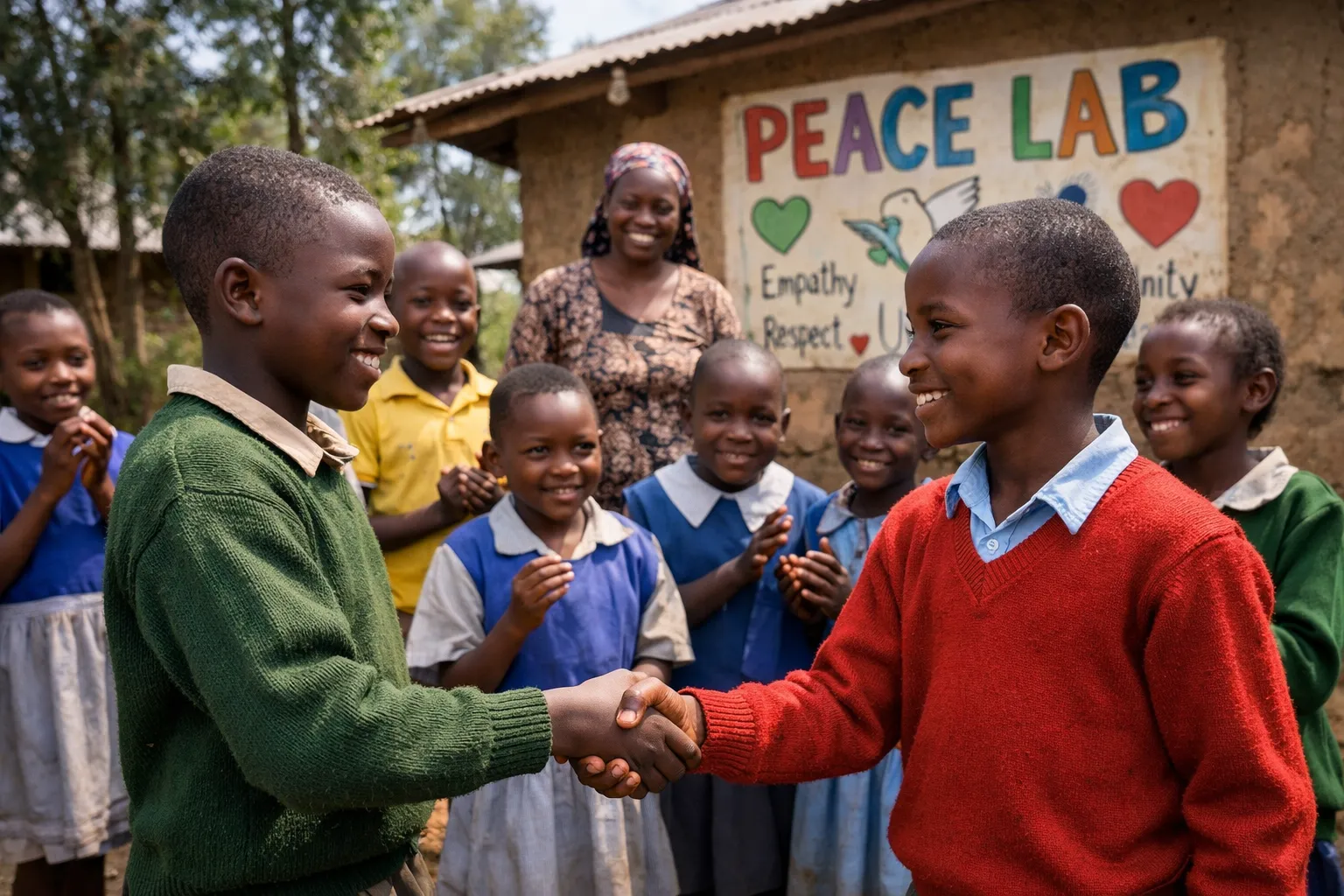
In many primary schools across Kenya, bullying and unresolved conflict quietly undermine learning, safety, and relationships. Disciplinary measures alone often fail to address the deeper emotional and social roots of aggressive behavior, leaving schools searching for more effective, lasting solutions. In one partner primary school in Vihiga County, western Kenya, a different approach began to take shape through Re-Imagining New Communities’s children-led peace lab, an initiative designed to help learners build empathy, emotional intelligence, and non-violent communication skills. What followed was not a quick fix or a scripted intervention, but a gradual and deeply human transformation. This is the story of how a peace lab helped turn a pattern of bullying into accountability, dialogue, and healing, beginning with two boys, Muyoka and Mukwano (not their real names).
When Bullying Becomes a Community Crisis
Muyoka was known throughout his school not for academic excellence, but for aggression. His temper was quick, his words often sharp, and his actions unpredictable. Mukwano, on the other hand, became the unfortunate target of Muyoka’s escalating behavior. What began as name-calling soon turned into pushing. Teasing evolved into intimidation. Before long, the conflict could no longer be dismissed as ordinary schoolyard behavior.
Teachers intervened. School disciplinary measures were applied. Counselling sessions were held. The boys’ families were brought in to help resolve the situation. Yet nothing seemed to work. What had started as bullying between two children grew into a wider community fracture. The relationship between the boys’ parents became strained, mirroring the hostility between their sons.
Introducing a Children-Led Peacebuilding Program
As part of its work under the Children-Led Community Peace Labs program, Re-Imagining New Communities had been supporting this primary school in Vihiga County to create a safer, more inclusive learning environment.
A school-wide assembly was held to launch the Peace Lab. Designed as a safe and supportive space, the lab allowed learners to explore empathy, emotional intelligence, non-violent communication, and practical tools for resolving conflict. Unlike traditional discipline systems, the Peace Lab centered children as active participants in building peace rather than passive recipients of correction.
To the surprise of teachers and peers alike, Muyoka signed up immediately.
The Slow Work of Personal Transformation
What followed was not a miracle, but the slow, deliberate work of transformation.
Within weeks, Muyoka became one of the most consistent and engaged members of the Peace Lab. He asked thoughtful questions that reflected a growing sense of self-awareness. He began to listen more than he spoke. He reflected on his behavior—not because he feared punishment, but because he was beginning to understand its impact on others.
Over time, the aggression stopped.
Mukwano noticed first. The taunting in the meal line disappeared. The shoving during break time ended. In its place were small, unfamiliar gestures—quiet greetings, shared tasks, moments of restraint. For Mukwano, these changes were confusing. Wounds shaped by fear and humiliation do not heal quickly. But what became clear was that Muyoka was no longer pretending. He was taking responsibility.
Learning Non-Violent Communication
During one Peace Lab session focused on non-violent communication, Muyoka was unusually quiet. He listened with an intensity the Peace Lab patron had not seen before. Something shifted.
A few days later, Muyoka approached Mukwano with an unexpected request: would he attend the next Peace Lab session with him?
At the meeting, Muyoka stood before the group and spoke openly. He acknowledged how he had treated Mukwano, how the Peace Lab had changed his thinking, and how deeply he wanted to make amends. It was not easy. It was vulnerable. And it was honest.
Moved by the supportive environment and Muyoka’s accountability, Mukwano agreed to speak. For the first time, the two boys had a real conversation. They named the pain. They acknowledged the harm. Then they made a bold commitment, to work together to promote peace within their school.
When Peacebuilding Reaches Families
The transformation did not end with the boys.
During the school’s Parents’ Day, Muyoka and Mukwano stood side by side, coordinating guest arrivals. Their parents, seeing them together, were visibly shocked and uneasy. Old tensions resurfaced as the two families came face to face.
Sensing the moment, the boys stepped forward. Calmly and clearly, they shared their journey. They spoke about the Peace Lab, what it had taught them, and how it helped them take responsibility, listen with empathy, and forgive. Their words were not dramatic. They were honest.
The parents listened. They looked at their sons, and then at each other. The change was undeniable. Tension gave way to silence. Silence softened into understanding. In that quiet moment, the seeds of reconciliation were planted.
Why Children-Led Peacebuilding Works
This story is not only about Muyoka and Mukwano. It is about what becomes possible when children are given the tools, the space, and the trust to become peacebuilders.
Children-led peacebuilding programs in Kenya, like the Community Peace Labs, are not extracurricular activities. They are incubators of transformation—within classrooms, between families, and across communities. They address conflict at its roots by equipping children with skills for empathy, dialogue, and accountability.
In this Vihiga County primary school, peace education stepped beyond textbooks and assemblies. It became a lived experience.
Growing Peace Together
Muyoka and Mukwano’s journey reminds us that peace is not passive. It is a choice, often difficult and uncomfortable, made in favor of understanding instead of anger, dialogue instead of silence, and healing instead of harm.
At Re-Imagining New Communities, we believe peace is not something we teach to children. It is something we grow with them.
And in a small primary school in western Kenya, we witnessed what that growth can become.