Every year on January 24, the world marks the International Day of Education, also informally known as World Education Day, to recognize the central role of education in promoting peace, sustainable development, and human dignity. Established by the United Nations General Assembly in December 2018, the day underscores education as a fundamental human right, a public good, and a shared global responsibility.
The observance seeks to reaffirm access to quality education for all, advance Sustainable Development Goal 4 (SDG 4) on inclusive and equitable education, and draw attention to global challenges such as poverty, conflict, and inequality that continue to deny millions of learners their right to education. In 2026, the day falls on Saturday, January 24, under the UNESCO theme “The Power of Youth in Co-Creating Education,” which emphasizes the leadership and agency of young people in shaping future learning systems.
For Kenya, this theme is particularly timely.
Why Education Matters to Kenya in 2026
Education has long been regarded as the cornerstone of Kenya’s national development agenda. It is a critical economic pillar under Vision 2030, the country’s blueprint for becoming a newly industrialized, middle-income nation. Studies consistently show that each additional year of schooling can increase an individual’s earnings by about 10 percent, making education one of the most reliable pathways to economic mobility.
Kenya’s demographic reality further elevates the urgency of education reform. With nearly 39 percent of the population under the age of 15, the country’s future prosperity depends on how effectively it equips its youth with relevant, 21st-century skills. Education remains the strongest social equalizer, offering children from marginalized backgrounds a chance to overcome structural inequalities and participate meaningfully in national life.
The year 2026 has emerged as a decisive moment for the sector. In January, more than 1.13 million pioneer learners under the Competency-Based Curriculum (CBC), now known as CBE (Competency Based Education), transitioned into Grade 10, marking the official rollout of Senior School and the introduction of pathway-based learning in STEM, Social Sciences, and Arts and Sports. This historic shift is unfolding amid persistent infrastructure gaps, teacher shortages, and funding pressures that have placed new financial burdens on families. At the same time, the government’s aggressive push to expand Technical and Vocational Education and Training (TVET) to two million learners by the end of 2026 signals a broader rethinking of how education aligns with employment and productivity.
What if every child in Kenya completed secondary school? The answer lies in stronger communities, a more skilled workforce, and a future defined by opportunity rather than limitation.
The Evolution of Education in Kenya
Kenya’s education system has evolved from a racially segregated colonial structure into a modern framework designed to support skills development and lifelong learning.
Before independence, education was deeply unequal. Missionary groups introduced Western-style schooling in the 19th and early 20th centuries, establishing institutions such as Rabai School in the 1840s and Alliance High School in 1926. Under colonial rule, education for African learners focused largely on basic literacy and manual skills suited to the colonial economy.
Following independence in 1963, the government adopted the 7-4-2-3 system, guided by the Ominde Report of 1964. This framework expanded access, promoted national unity, and sought to build a competent African workforce. However, it was later criticized for being overly academic and poorly aligned with labor market realities.
In 1985, the 8-4-4 system replaced it, emphasizing education for self-reliance and introducing vocational subjects. While the system significantly broadened enrollment, especially after the introduction of Free Primary Education in 2003, it gradually became exam-oriented and burdensome for learners and families.
The launch of the Competency-Based Curriculum in 2017 marked a turning point. Structured as 2-6-3-3-3, the CBC prioritizes mastery of competencies such as critical thinking, creativity, and digital literacy. The transition of the first CBC cohort into Senior School in January 2026 represents one of the most ambitious education reforms in Kenya’s history.
The Impact of Education on Kenyan Communities
Across Kenya, education functions as a powerful engine for social mobility and community development. Its economic impact is especially pronounced. Households led by individuals with secondary education earn, on average, three times more than those with only primary schooling, while university graduates earn up to 167 percent more than secondary school leavers. In 2026, TVET graduates in specialized fields such as renewable energy and digital infrastructure are increasingly securing stable incomes faster than many traditional degree holders.
Education also plays a central role in breaking intergenerational cycles of poverty. Educated families are more likely to diversify income sources, invest in health and nutrition, and support continued education for their children. In rural areas, schooling has improved agricultural productivity, with educated farmers adopting climate-smart practices and digital market tools that enhance yields and resilience.
Socially, education is closely linked to improved health outcomes, lower fertility rates, and higher child immunization coverage. It has been instrumental in advancing gender equality, helping reduce early marriages and harmful practices such as Female Genital Mutilation. Civic engagement is also stronger among educated populations, who are more likely to participate in democratic processes and community leadership.
Culturally, education has enabled communities to preserve and reinterpret their heritage. Through music, drama, and language programs, schools continue to celebrate Kenya’s diversity while empowering marginalized groups, particularly in Arid and Semi-Arid Lands, to engage more fully in national development.
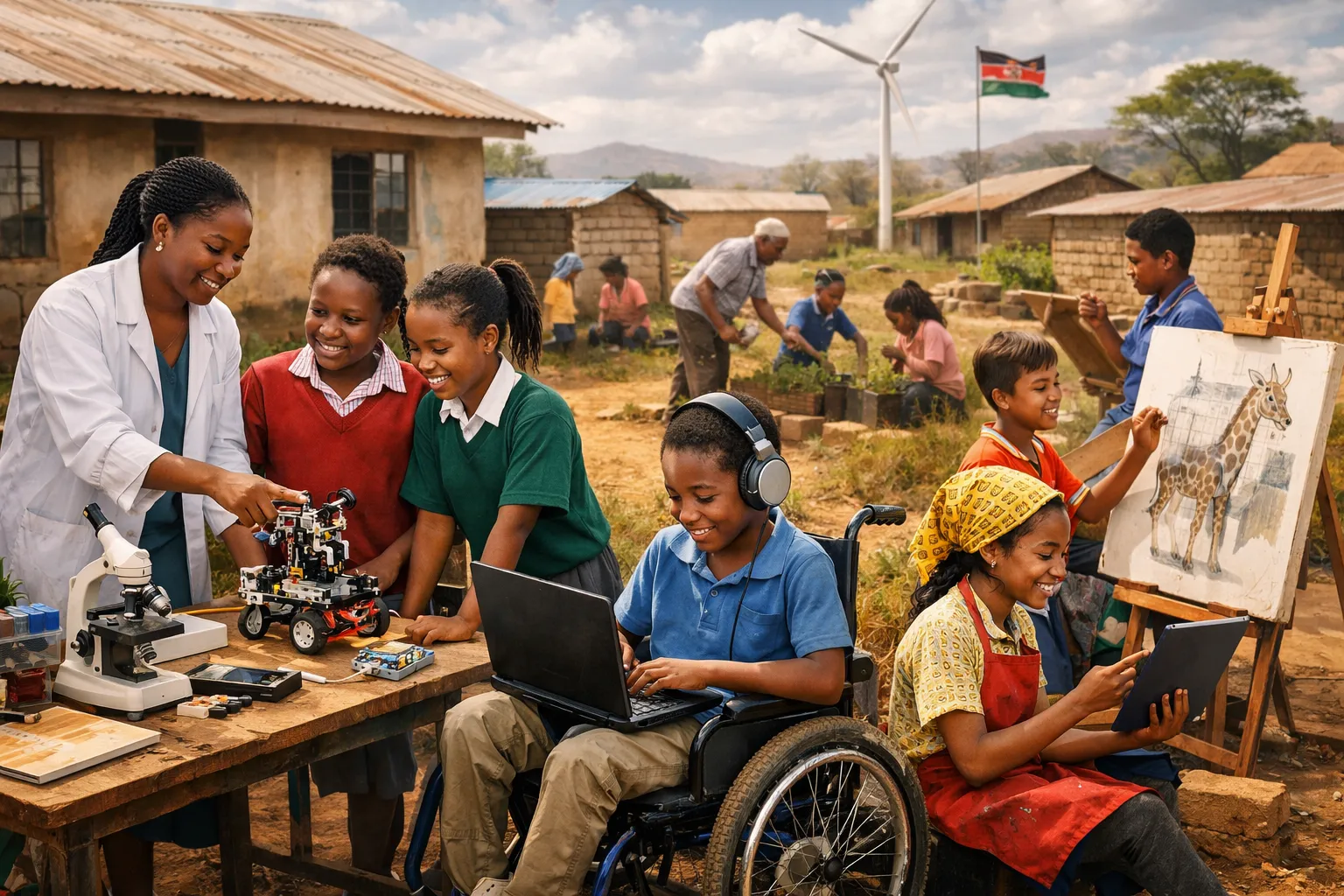
Real-world examples illustrate this transformation vividly, from digital learning hubs in Narok supporting pastoralist livelihoods, to community-led schools in Kibera producing young women leaders, green school initiatives in Kilifi enhancing food security, and mobile schools in Turkana ensuring education follows nomadic children rather than excluding them.
The Current State of Education in Kenya
In 2026, Kenya’s education sector is characterized by record enrollment levels alongside a complex transition to Senior School under the Competency-Based Education (CBE) system. While the government maintains a 100 percent transition policy from primary to secondary education, actual enrollment in the pioneer Grade 10 cohort is reported to stand at approximately 30 percent, reflecting persistent access barriers. This means that nearly 800,000 learners out of the expected 1.13 million have yet to report to their assigned schools, an outcome that sharply contrasts with historical transition rates. This shortfall signals deeper systemic challenges that threaten the very foundation of CBC reform.
Although the Ministry of Education assured a 100 percent transition, emphasizing equity, talent nurturing, and preparation for either university education or entry into the world of work after Grade 12, the reality on the ground tells a different story. Rural and most public schools remain disadvantaged, lacking critical infrastructure such as science laboratories, ICT facilities, internet connectivity, and adequate learning materials. In contrast, many urban and private schools are comparatively well resourced. This imbalance has widened existing gaps, raising serious questions about equity within Kenya’s education system.
Quality remains a major concern, with growing scrutiny over the rapid progression of young learners from pre-primary levels, particularly amid shortages of trained teachers, textbooks, and adequate infrastructure in many schools. The country continues to face a significant teacher deficit, with acute shortages in STEM and technical subjects. Despite government recruitment efforts since 2022, the target of hiring 100,000 teachers by 2026 has yet to be met. The increasing reliance on internship-based employment has further weakened retention, as many teachers exit the profession due to delayed confirmation into permanent and pensionable terms, exacerbating the existing shortage.
Infrastructure gaps are equally pressing. Many schools still lack functional science laboratories required for pathway-based learning. Placement challenges during the first CBC Senior School intake have also emerged, with some learners reportedly assigned to day schools located far from their homes, an issue that remains unresolved. As a result, many students have been left stranded at home while seeking alternative placements that have yet to materialize. High school fees, particularly in boarding schools, have further compounded the crisis, leaving financially strained parents unable to enroll their children. Even with government capitation, households continue to face daunting out-of-pocket costs related to uniforms, books, transport, and additional school levies.
Inclusion challenges persist for learners with disabilities despite existing legal protections. Underfunding, limited assistive technologies, inaccessible infrastructure, such as the absence of ramps, lifts, and accessible toilets, and a severe shortage of teachers trained in special needs education continue to hinder meaningful inclusion. Deep-seated societal stigma and negative attitudes further contribute to low transition rates from primary to secondary school and high dropout levels among learners with disabilities. These realities expose a significant disconnect between policy and practice, leaving many learners excluded from mainstream education. A recent case in which a learner with a disability was initially denied admission to a national school for Grade 10 on the grounds that the institution was “not meant for them”, highlights the persistent ignorance, misconceptions, and discrimination faced by persons with disabilities, even though the case was later resolved.
Insecurity in several parts of the country has also disrupted access to education. In some regions, particularly in northern Kenya, learners continue to attend schools located near active conflict zones, studying amid gunfire and community clashes. In other areas, schools have been converted into temporary shelters for displaced families. These conditions raise serious concerns about children’s basic rights to safety, freedom, and quality education. How can learners exposed to such instability be expected to compete on equal footing with peers studying in peaceful, well-resourced private schools in urban centers and later enter the same job market under equal expectations?
Digital transformation has accelerated, with more than 1.2 million devices distributed to primary schools and widespread adoption of e-learning platforms in higher education. However, stark disparities remain. Many rural schools still lack electricity, internet connectivity, ICT infrastructure, and trained personnel, reinforcing a digital divide that continues to disadvantage rural learners and threaten equity across the education system.
Unless effective and urgent interventions are implemented, the risk of missing the 100 percent transition goal becomes increasingly real, undermining years of curriculum reform and public investment. Each unenrolled learner represents a dream deferred or derailed, a potential dropout, and a missed opportunity to harness talent for national development.
Where Education Can Lead Kenya
Looking ahead, Kenya’s education system is shifting from schooling for certification to learning for utility. The emphasis on STEM pathways, entrepreneurship, and market-aligned TVET programs positions education as a driver of innovation, job creation, and sustainable development.
Inclusive design, through assistive technologies and community-led delivery models, offers the potential to ensure that no learner is left behind. Education remains central to achieving Vision 2030, fostering peace, social cohesion, and environmental sustainability. However, given the challenges currently facing the sector, the Ministry of Education, the government, and all stakeholders must work collaboratively, and with urgency, to realize this vision. With only four years remaining to 2030, the question remains: will Kenya achieve the ambitious milestones envisioned under Vision 2030 as planned?
Conclusion
Investing in education is no longer simply about expanding access; it is about securing Kenya’s future. As the country implements its most ambitious curriculum reforms to date, every investment in a learner’s skills represents a commitment to national stability, economic resilience, and shared prosperity.
Education is the bridge between the Kenya of today and the equitable, industrialized nation envisioned in Vision 2030. By empowering youth as co-creators of learning, the country ensures that opportunity remains within reach for every child, from the streets of Nairobi to the plains of Turkana.
As one education policy expert aptly observes, when learners choose their pathways today, they are not merely selecting subjects; they are shaping how they will build the Kenya of tomorrow.